Following on from the boredom jar post, the item that came up on repeat as “the whole family” idea was board games. So I scoured the internet for ones that deserve our coveted shelf space.
Mumsnet’s testers make a fair point in their 2026 round-up: the games that earn their place aren’t necessarily the ones you loved as a kid, they’re the ones with enough of an “X factor” that people actually ask to play again. That’s the bar I’ve used below.
Ages 3-5: Count Your Chickens
At this age the game needs to survive a short attention span and an even shorter tolerance for losing. Forbes Vetted’s round-up of the best board games for kids highlights cooperative games for this age group, where everyone wins or loses together, which sidesteps the meltdown-over-losing problem almost entirely. Our pick is Count Your Chickens, where the whole table works together to get Mother Hen’s chicks back to the coop before the fox arrives. Everyone wins or loses as a team, and there’s a counting element that sneaks in some early maths.
Why we’d get it: No reading, no real strategy, and nobody storms off because they came second.
Watch out for: Small pieces. Check the age rating matches your youngest player, not your oldest.
Ages 6-8: Catan Junior
Regular Catan is a rite of passage for the 10-plus crowd, but Mumsnet’s tried-and-tested family board games guide rates Catan Junior, the pirate-themed version for ages six and up, as arguably even better than the original according to their testers. It keeps the trading and building that makes Catan so replayable, just with a simpler board.
Why we’d get it: It teaches proper strategic thinking without being frustrating for a six-year-old, and it grows with them.
Watch out for: It takes longer to explain than a party game. Budget a proper first game night rather than squeezing it in before bed.
Ages 8+: Ticket to Ride
This is the one that keeps coming top of “gateway game” lists, and for a good reason: it teaches in about five minutes and genuinely holds up for adults, not just kids being humoured. Players collect coloured train cards and claim routes across a map, and the rules stay simple even as the strategy deepens. You can find Ticket to Ride on Amazon.
Why we’d get it: It’s the rare game where an eight-year-old and a grandparent are making genuinely comparable decisions.
Watch out for: Games run 30-60 minutes, so it’s not a five-minutes-before-dinner option.
Any age, no reading needed: Dixit
Dixit uses beautifully illustrated, slightly surreal cards and a one-word or one-phrase clue system, so there’s no reading required and no real “right” answer to get wrong. It’s one of the few games that genuinely bridges generations, since a grandparent and an eight-year-old are on completely even footing.
Why we’d get it: It works at a mixed-age family gathering better than almost anything else on this list.
Watch out for: It needs at least three players to work properly, so it’s not one for a quiet two-player evening.
For chaos in under ten minutes: Exploding Kittens
This is the game to pull out when everyone’s too tired for anything with real rules. Exploding Kittens has almost no learning curve and gets a table laughing within a couple of rounds, which makes it a genuinely good stocking filler too, alongside the trending toys we rounded up for Christmas 2026.
Why we’d get it: Ten minutes, zero setup, and it travels in a coat pocket.
Watch out for: The base game has some cartoonish peril (exploding kittens, obviously), so check the box for the age guidance if your youngest is sensitive to that kind of thing.
The one that actually travels: UNO
Old news, but worth including because it’s genuinely the most portable game on this list: a deck of cards weighs nothing and fits in any bag. UNO‘s 2026 edition also added colour-blind-accessible symbols, which is a small but useful update if that affects your family.
Why we’d get it: It’s the one that actually survives a long car journey or a restaurant table.
Watch out for: Nothing, really, other than losing a card down the side of the car seat.
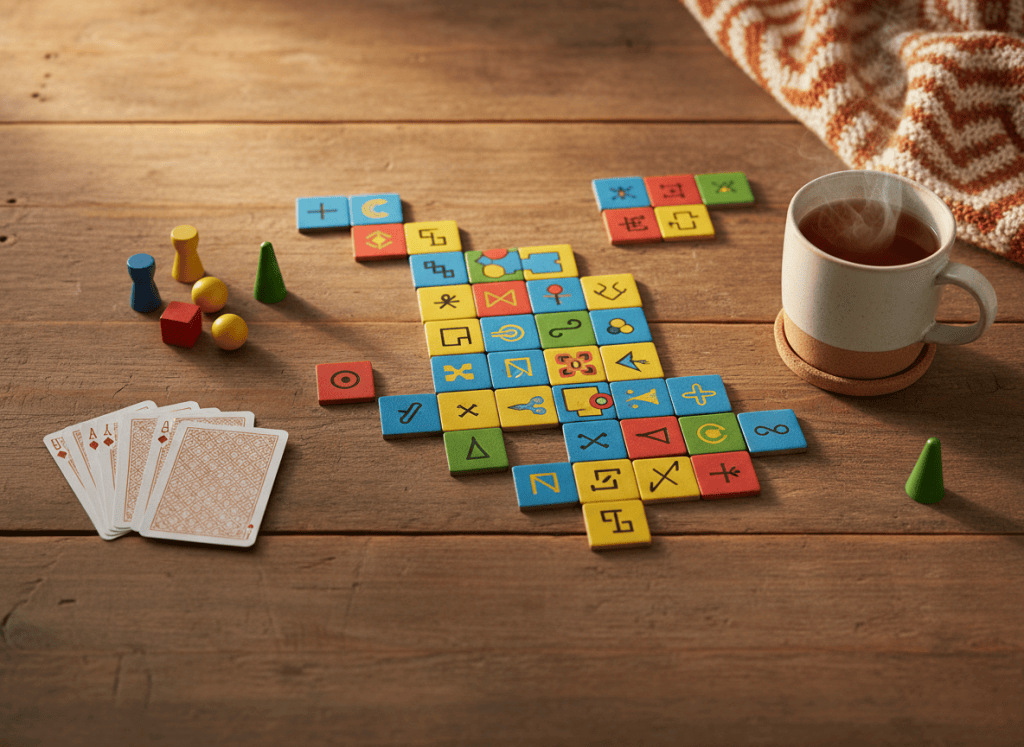
If you’re buying one to last: Carcassonne
Mumsnet’s testers rate Carcassonne for how flexible it is: it’s a fast-paced tile-laying game that’s easy to steer towards a quick conclusion if you’re short on time, or let run long if nobody’s in a rush. That kind of flexibility is rare in a strategy game.
Why we’d get it: It scales from a quick 20-minute game to a proper hour, depending on the night.
Watch out for: The tiles are small and easy to lose down the sofa. A box with proper compartments is worth the extra few pounds.
Before you buy anything
- Buy for your youngest regular player, not your oldest. A game that’s slightly too easy for the eldest still gets played; a game that’s too hard for the youngest gets abandoned.
- Check the box for small parts if you’ve got younger siblings who’ll be in the room even if they’re not playing.
- One good strategy game beats three mediocre ones. The games that get replayed are the ones with a bit of depth, not the ones that were cheapest.
So which would I actually buy?
For a rainy Saturday with a mixed-age group: Dixit.
For a family that’s ready to level up from Snakes and Ladders: Catan Junior.
For the car, the plane, or a restaurant table: UNO.
For everyone too tired to think: Exploding Kittens.
Pick one, actually play it more than once, and it’ll earn its spot on the shelf far more than whatever’s currently gathering dust behind it.