As I edge towards the big ‘40’, I’ve noticed myself becoming far more interested in what goes into our food. I scan labels, look for ingredients I recognise and have occasionally returned a supposedly “simple” snack to the shelf after discovering it contains half the contents of a chemistry cupboard.
I’m especially conscious of what my children are eating. Yet when it comes to skincare, I’ve realised I haven’t always been quite so curious. Our skin is the largest organ in the human body, so you would think we’d pay far more attention to what we put on it.
Cleansers, serums, moisturisers and oils promise everything from brighter skin to a youthful glow, so we trust the bottle and hope for the best.
The reassuring part is that understanding skincare doesn’t require a chemistry degree. It begins with looking beyond the promises on the front and paying a little more attention to what is inside.
Natural Doesn’t Automatically Mean Better
Skincare is awash with words such as natural, clean, green and non-toxic. They sound reassuring, but they don’t always have clear or consistently regulated definitions.
A natural ingredient can still irritate your skin, just as a carefully formulated synthetic one can be perfectly safe and effective. Essential oils are a good example: wonderfully wholesome in theory, but potentially irritating for sensitive skin.
Equally, a long scientific name isn’t necessarily something to fear. Sometimes it is simply the technical name required on the label.
The point isn’t to divide ingredients neatly into “good” and “bad”. It is to understand what they do and, more importantly, whether they suit your skin.
Start with the Labels
Ingredients are generally listed in order of concentration, with those used in the largest amounts appearing first. So, if a product makes a great fuss about a botanical extract that appears near the end of the list, it may only be present in a small quantity.
That doesn’t automatically make the product ineffective – some active ingredients are only needed in low concentrations – but it does help separate the formulation from the marketing.
I’ve also started paying more attention to the ingredients my skin seems to like. Glycerin, hyaluronic acid and squalane commonly support hydration, while niacinamide can help with uneven tone and excess oil. Fragrance, alcohol and essential oils aren’t automatically unsuitable, but they are worth watching if your skin tends to react.
For example, The Ordinary helped make this ingredient-led way of shopping feel more accessible by putting ingredients and concentrations front and centre. The slight problem is that it also made it tempting to buy several concentrated treatments without knowing whether they should ever share the same bathroom shelf, let alone the same face.
More information is useful. More products are not always necessary.
Your Skin Doesn’t Need a Ten-Step Routine
The more I learn about skincare, the more convinced I am that most of us don’t need an elaborate routine.
A gentle cleanser, a suitable moisturiser and daily sun protection provide a sensible foundation. Anything else can be introduced gradually to address a particular concern.
Using too many active ingredients at once makes it almost impossible to know what is helping and what is causing irritation. Retinoids, exfoliating acids and vitamin C can all have a place, but combining everything is not necessarily a shortcut to better skin.
Brands such as Typology have embraced streamlined, ingredient-conscious routines, while Pai has centred much of its approach on sensitive and reactive skin. Both show that skincare can be thoughtful and effective without turning the bathroom into a small laboratory.
Ingredients Are Only Part of the Story
Once you begin asking what is inside a product, it becomes difficult not to wonder where those ingredients came from, how the product was made and what happens to its packaging afterwards.
The beauty industry produces an extraordinary amount of waste, from single-use samples and plastic bottles to elaborate boxes. Usable plant materials are also discarded by the food and drinks industries before a skincare product is ever made.
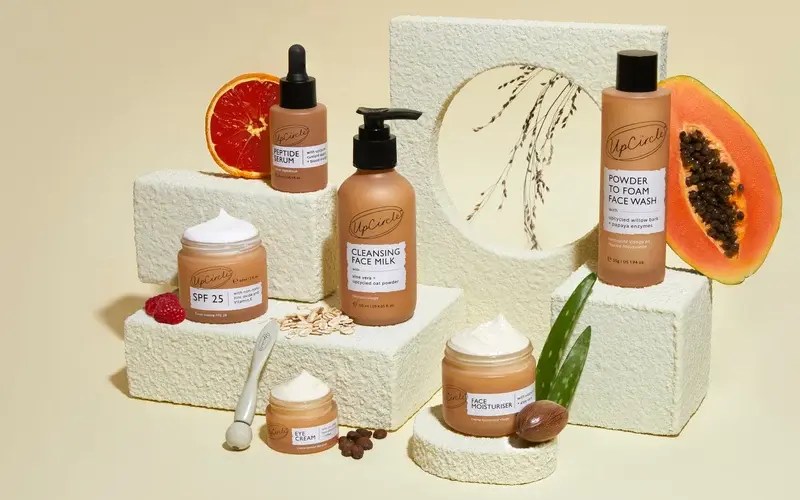
This is what makes UpCircle so interesting. The brand gives ingredients that might otherwise go to waste—including used coffee grounds and fruit by-products—a new purpose in skincare. It is circular thinking in its most practical form: finding value in something that already exists.
Pelegrims, another personal favourite, takes a similar approach in the vineyards. It uses winemaking by-products such as grape skins, seeds and vines, which contain polyphenols including resveratrol.
What I particularly like about Pelegrims is the sense of place behind it. The brand connects its formulations to a particular landscape and process, treating skincare ingredients with the same curiosity we increasingly bring to food and wine.
Both brands prove that sustainability and performance do not have to compete. An admirable environmental story isn’t enough on its own—the product still has to work—but it can make a good product feel like a much better choice.
Transparency Matters More Than Perfection
There is no perfect skincare brand, ingredient list or routine. What works brilliantly for one person may irritate another or do very little at all.
What matters is transparency. Brands should make it easy to understand what a product contains, why those ingredients are there and how it should be used, rather than relying on vague promises of purity, detoxification or transformation.
We don’t need to fear every ingredient we cannot pronounce. We simply need to ask better questions.
What is this product meant to do? Which ingredients are doing the work? Does it suit my skin? Is the brand open about its formulation and sourcing? And, most importantly, do I actually need it?
Knowing what goes on your skin isn’t about creating fear. It is about making more informed choices—and occasionally realising that the product you already own is perfectly good enough.